
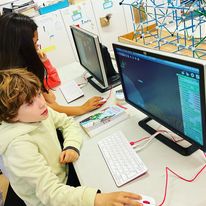
Is the use of social networks and mobile devices appropriate for children from 3 to 6 years of age?
One of the most striking aspects of our school is the non-existence of digital technology in the classrooms up to the age of 9.
In recent years there has been much debate about the integration of digital technologies, specifically the use of cell phones, in schools. From Zaragoza SchoolHouse's point of view, as a Montessori school, the disadvantages of cell phone use in early childhood settings outweigh the advantages.
For this reason, the use of phones, tablets, digital screens or computers are not found in Zaragoza SchoolHouse environments.
Use of mobile devices in a Montessori classroom
In the Montessori vision of Zaragoza SchoolHouse, young children learn best through concrete, multisensory experiences. This is especially true for children from birth to three years of age(Comunidad Infantil classroom), but remains significant for children from three to six years of age(Casa de niños y niñas classroom). During the years from three to six years of age, children's development continues to depend on physical movement. Increasingly, children become interested in manipulating real objects to achieve meaningful goals in the concrete and social world around them.
During such an activity, as children learn to regulate and fine-tune their hand movements, they also learn to regulate their mental attention and, therefore, their ability to concentrate. In addition, purposeful activity involving the manipulation of real objects allows children to refine their powers of perception and discrimination using all of their senses. During these years, children also need to interact with people who are physically present to develop the ability to build personal relationships and culturally appropriate behavior. This is especially important in language development and learning both English and Spanish.

Effects on children aged 3 to 6 years from the use of social networks and mobile devices.
In Montessori early childhood settings, screen-based activity has the potential to displace children's work with Montessori materials.
Screen time is defined as inactive "sedentary nonproductive behavior" that for extended periods is associated with:
- less active, outdoor, creative playtime
- an increased risk of being overweight
- suboptimal muscle and bone growth
- unhealthy eating habits
- poorer social skills
- less opportunity to develop decision-making, self-awareness and self-regulation skills
- slower development of language skills and short-term memory
- Television viewing habits that continue throughout childhood.
From Zaragoza SchoolHouse's perspective, the knowledge and skills that children develop through working with Montessori materials prepares them very effectively for later use of digital technologies. Experience in Zaragoza SchoolHouse classrooms has shown that children who have made the transition from the three- to six-year-old environment to the next stage of education, even if they have not had access to a computer at home, can use computers or mobile devices with ease and success in the future. This may be because the skills developed in the Three to Six environment, especially in practical life exercises and sensory exercises, indirectly prepare children for successful computer use.

These skills include:
- Coordination and fine motor control that prepares children to use a mouse and keyboard
- the ability to sequence and observe
- the ability to handle abstract concepts
- Higher order thinking and problem solving skills.
- Procedural thinking.
These skills become a resource that children apply when they then work with digital technologies. Furthermore, successful engagement with digital technologies requires the ability to be multi-literate, in other words, to be literate in 'multimodal forms of communication across linguistic, visual, auditory, gestural, and spatial forms' that require 'the knowledge and skills necessary to read, write, and use spoken and written language, sounds, and images' (Hill 2007: 56). Montessori educators would argue that the diverse multimodal resources and activities in Montessori early childhood settings equip children par excellence with the knowledge and skills that will prepare them for success in a world in which digital technologies and multiple forms of literacy play an important role.

Social networks and technology with adults
However, digital technology is a resource used by adults in Montessori early childhood settings. For example, images and information accessed through the Internet are regularly used to prepare and customize resources to meet each child's specific learning needs. Digital cameras are also used to record and document children's progress, as well as field trips or other special events. Teachers also use digital technologies to keep records and communicate with families and colleagues.